
Bitcoin M1 To M5 Buy sell Tradingview || Custom Pine Script indicators for TradingView
Original price was: $3,999.00.$199.00Current price is: $199.00.
- Clear visual signals
- Works on multiple timeframes
- Suitable for Tradingview market
- Helps identify reversal points
- Simple trading rules
- Unlimited Tradingview Free Plan
- Trading time: Every time
- Instant Download in Zip file
- Timeframe: M1 to W1
- Source Code:- Pine script
- Lifetime Version
Bitcoin M1 To M5 Buy sell Tradingview || Custom Pine Script indicators for TradingView
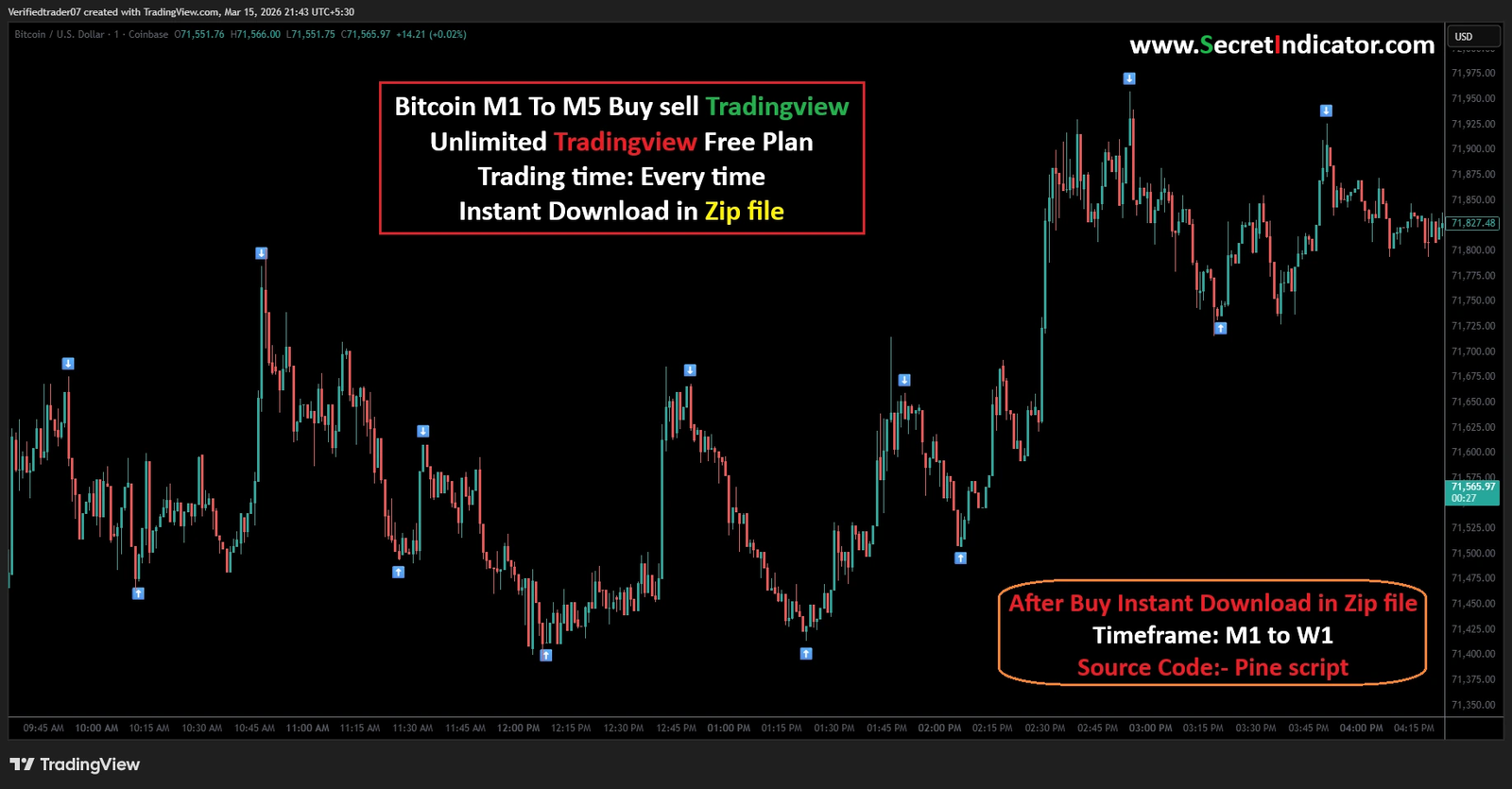
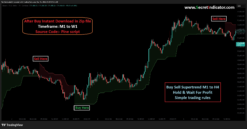
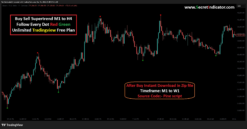
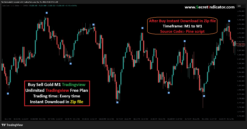
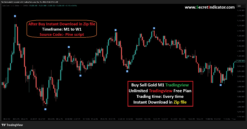
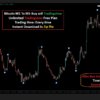
Scalping BTC/USD using the M1 “Buy-Sell” Indicator
Overview of the Strategy from the Image
This new image focuses heavily on Scalping. This is an ultra-short-term trading style.
-
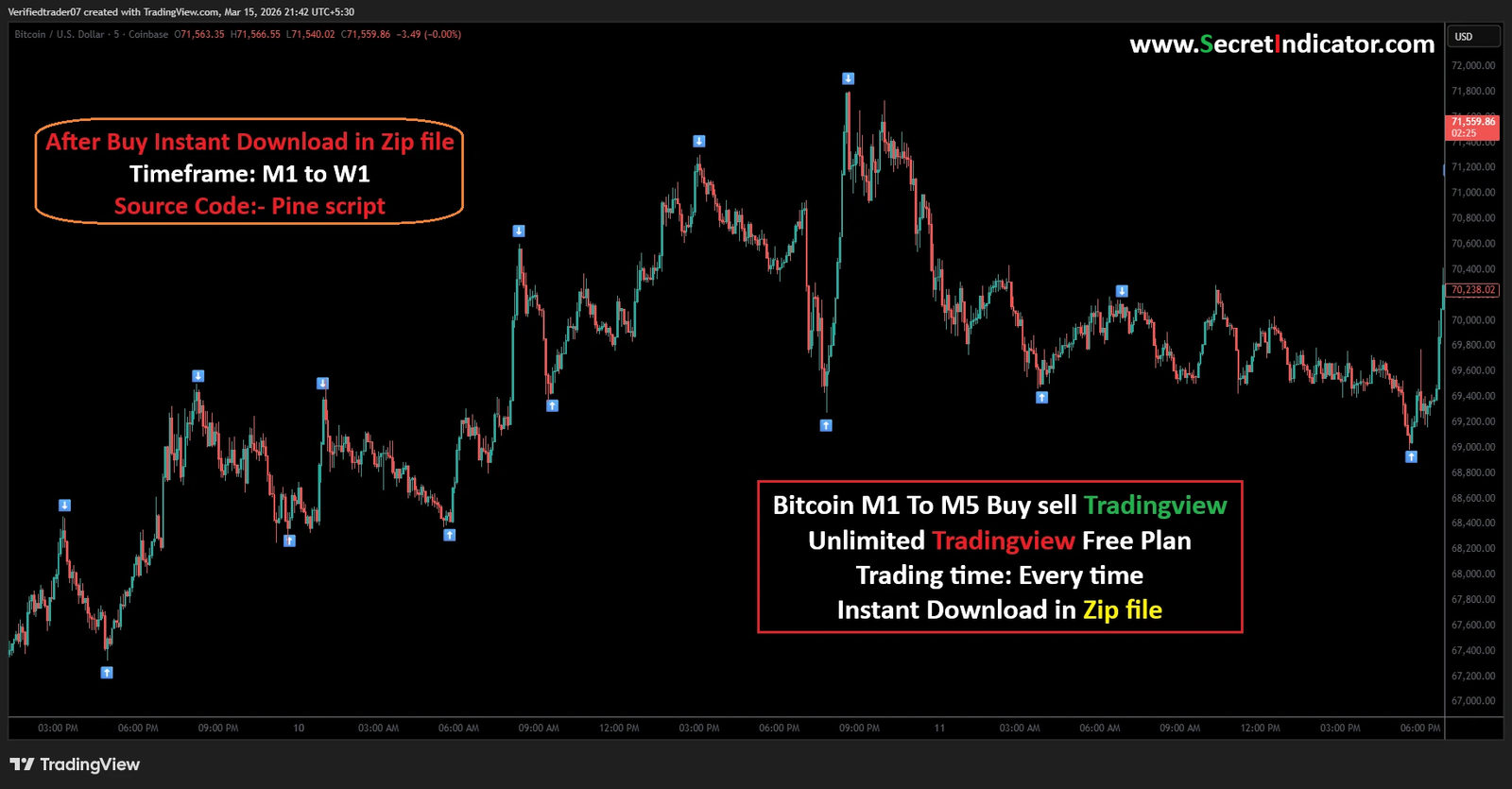
Timeframe Focus: M1 to M5 (1-minute and 5-minute charts). This is clearly advertised for very fast trades.
-
Asset: Bitcoin (BTC/USD).
-
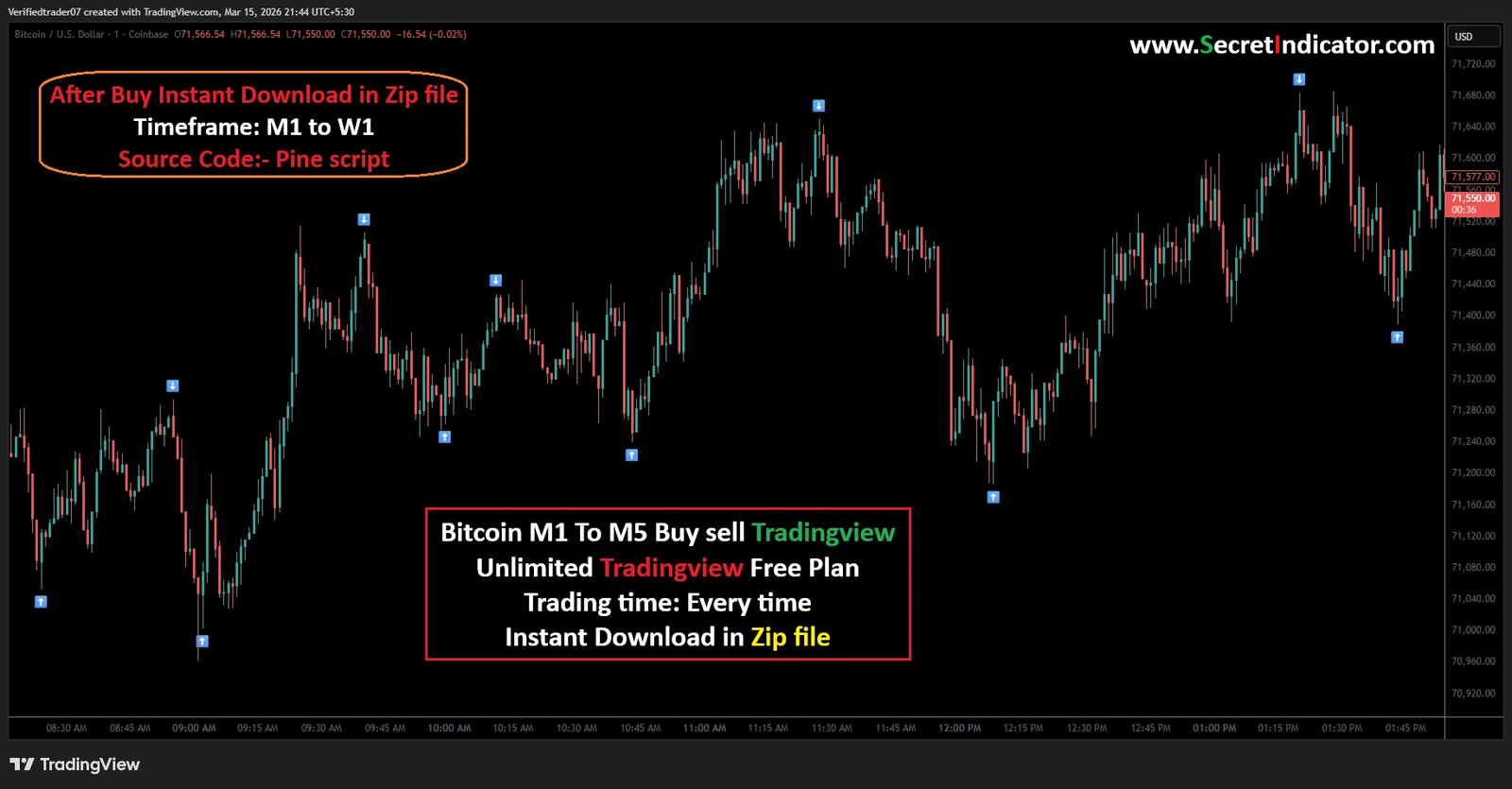
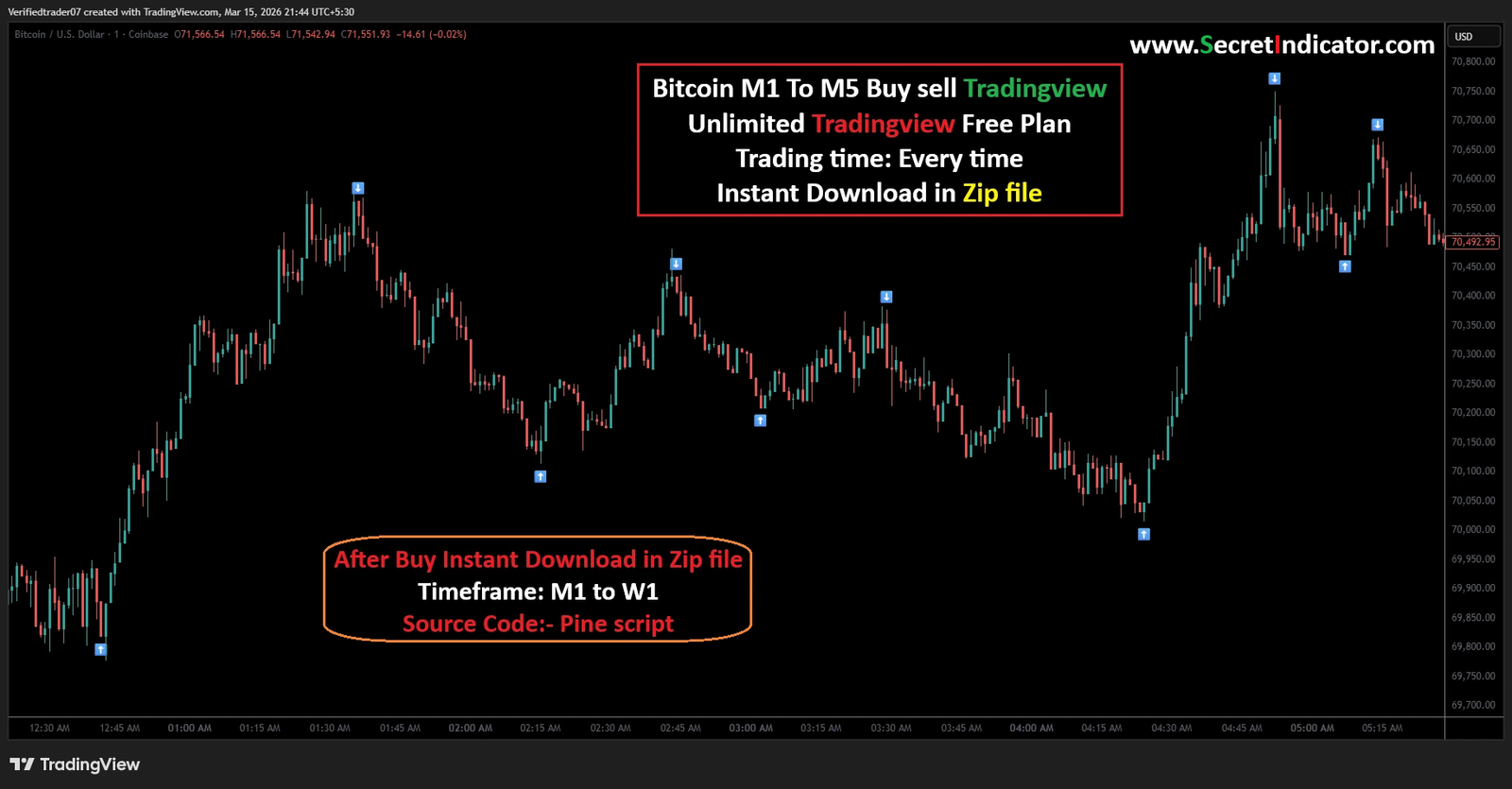
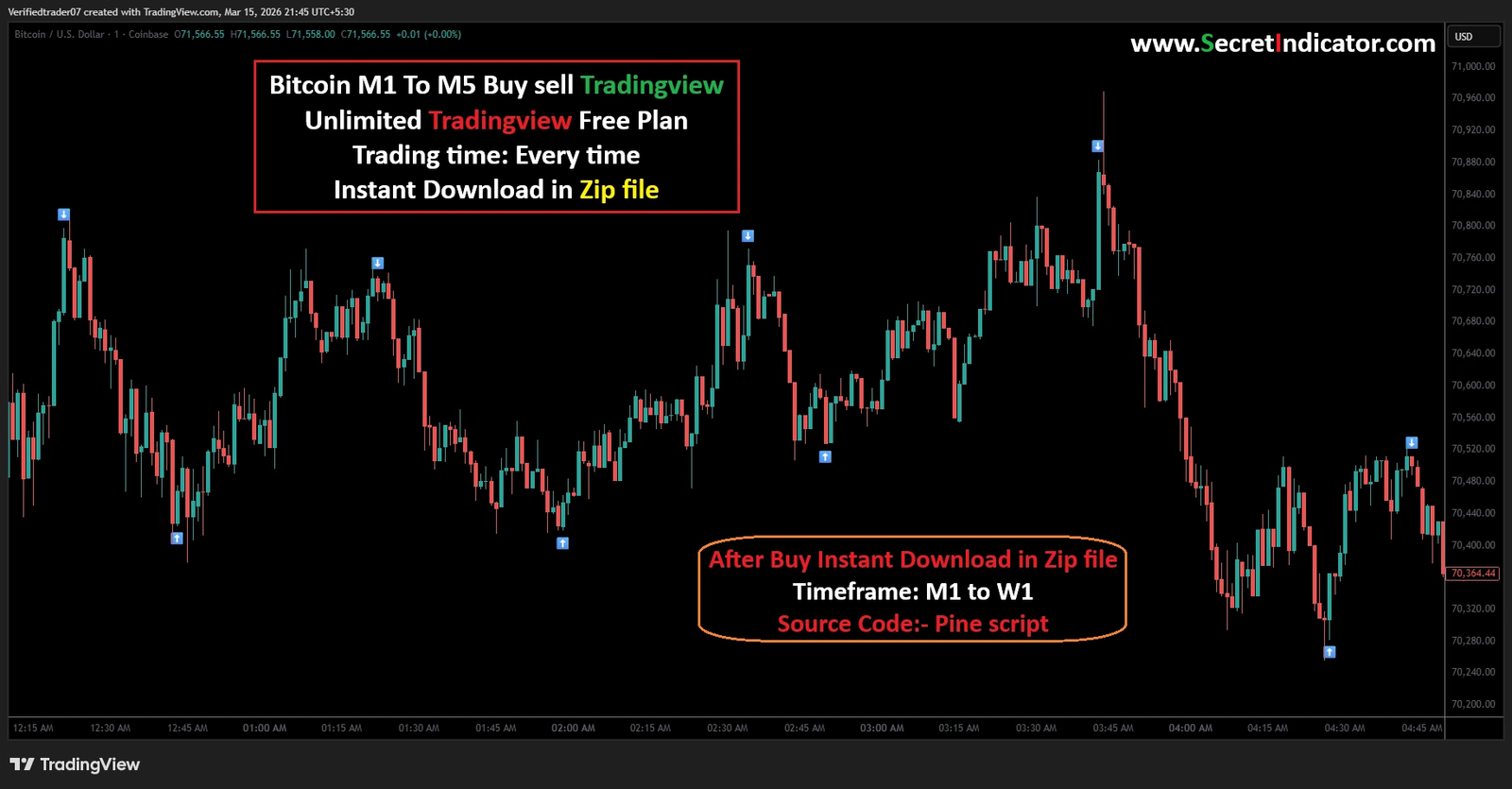
Signal Style: Discrete points (small blue arrows/markers above/below specific candles), not large colored zones like the previous image.
1. Setting Up the Trade (Stop Loss and Take Profit)
Because you are trading on the 1-minute chart, your entry point is crucial. You must enter immediately when the candle closes and the signal arrow appears. The price moves incredibly fast.
A. Placing the Stop Loss (SL)
Scalping leaves zero room for error. If the price goes against your short-term signal, it means the indicator was wrong right then. You must exit quickly.
-
For a BUY (Up Arrow below a candle): Place your Stop Loss (SL) immediately below the wick of the signal candle or the previous candle’s low. This is typically a very small distance, perhaps 0.10% to 0.20% of the asset’s price.
-
For a SELL (Down Arrow above a candle): Place your Stop Loss (SL) immediately above the wick of the signal candle or the previous candle’s high.
B. Placing the Take Profit (TP)
When scalping, you take quick profits before the short-term momentum fades. You have two main choices:
-
Option 1: Fixed Risk-to-Reward: This is the most structured method. If your calculated risk (entry to SL) is $100, your target TP should be at least $150 or $200 (a 1:1.5 or 1:2 ratio). You must take your profit as soon as it hits your target dollar amount.
-
Option 2: Next Signal Exit: You hold a BUY until a dynamic SELL signal (the down arrow) appears, and vice versa.
-
Warning: This is highly risky on a 1-minute chart. As shown in your chart, sometimes opposing signals (a BUY followed immediately by a SELL) occur very close together. You can get “whiplashed,” losing money on the bid-ask spread and small movements while your profit vanishes. A proactive TP target is usually safer for beginners.
-
2. Mastering Risk Management (Ultra-Short Term)
Risk management is everything in scalping. The high trade volume amplifies small mistakes.
-
The 0.5% Rule: Because you will be taking many trades quickly, consider reducing your risk per trade from 1% to just 0.5% (max) of your total account balance. If you have a $10,000 account, never risk losing more than $50 on a single 1-minute trade.
-
Control Transaction Costs (The “Silent Killer”): Scalping is highly sensitive to costs. The bid-ask spread and trading fees can turn a 1:2 profitable signal into a losing trade after costs. You must use a broker/exchange with the tightest spreads possible (raw spread accounts are preferred).
-
Total Daily Stop-Loss: If you have five losing trades in a row (or hit 2.5% of your account loss for the day), STOP TRADING. Walk away for the day to reset your mind. Continuing to trade leads to “revenge trading” and large losses.
3. Setup, Installation, and Important Technical Details
The text on your image specifies:
-
“After Buy Instant Download in Zip file”
-
“Source Code:- Pine script”
-
“M1 To M5 Buy sell Tradingview”
What you must understand about this specific type of script:
-
Pine Script (TradingView): Like the previous example, this is a TradingView indicator. You cannot install a Pine Script on MetaTrader (MT4/MT5).
-
Repainting Alert: Indicators designed for M1 timeframes that give specific point signals (like small arrows) are notoriously prone to repainting.
-
What is Repainting? The signal arrow might appear during a candle’s formation when the price looks like it’s reversing, but if the price closes differently, the indicator will move or delete the signal entirely, pretending it was never wrong. This makes backtesting look amazing but live trading impossible.
-
Crucial Rule: Before trusting any M1 signal script with real money, you must “replay” the chart in real-time mode (using TradingView’s Bar Replay or simply watching it on a live chart) to confirm that the signals do not disappear once the candle closes. If they disappear, do not use the indicator.
-
4. Extra Expert Tips for M1 Scalping
-
Trade Volume: Look for signals during high-volume periods (like when London and New York sessions overlap, or when major financial markets open). High volume provides the liquidity needed for scalping to work correctly.
-
Master the Exchange Interface: Make sure you can enter, place SL, and set TP almost instantly. Even a 5-second delay on an M1 chart can ruin a trade. Use one-click trading tools if available.
-
Trend is Your Friend (Even on M1): While you can scalp a sideways market, the most reliable M1 signals often align with the trend of a higher timeframe. If the H1 chart is showing a strong uptrend, only take the M1 BUY signals and ignore the SELL signals.
Our Payment Options:
1) Bitcoin Wallet:
2) USDT(Tether) Wallet: (Request)
3) TRX(Tron) Wallet: (Request)
4) XRP(Ripple): Tag(Request)
And another crypto wallet: on request
5) Visa/Master Card Via Payment Link: On Request
6) Paypal: Not Accept
7) Skrill: On Request
8) Neteller: On Request
9) Western Union: On Request
10) This Website(www.secretindicator.com). You can purchase directly from the website with Your Credit/Debit Cards and All cryptocurrencies and Instant Download Indicator Files.
Send payment screenshot to: 
Payment After we will provide the product within 90 minutes.
If you want any proof of Indicator or have any questions then feel free to message
Mail Us: Click Here
Whatsapp: Click Here
Telegram: Click Here
Thank You 
Be the first to review “Bitcoin M1 To M5 Buy sell Tradingview || Custom Pine Script indicators for TradingView”
Related products
Reviews
There are no reviews yet.